When she crossed the muddy field at dawn, Amina carried more than a small bundle of clothes; she carried the fragile logic that a roof and a clinic could mean the difference between life and loss. Across the globe, that logic is under siege: the UN Office for the Coordination of Humanitarian Affairs reports that 339 million people will need humanitarian assistance in 2024 — a scale few of us can imagine (Global Humanitarian Overview 2024).
Those needs are not abstract. Forced displacement has surged: UNHCR reported 108.4 million people forcibly displaced worldwide at the end of 2022 — a crisis that continues to reshape health access, shelter availability, and the basic dignity of families on the move (UNHCR Global Trends 2022). At the same time, inequities in care mean many arrive at camps or informal shelters without reliable access to essential health services — a reality the World Health Organization frames as a global health equity challenge (WHO: Health Equity).
Training: the multiplier that saves lives
One promising answer is local capacity-building. When international teams train community health workers, midwives, and shelter managers, those communities gain lasting resilience. Organizations like Doctors Without Borders (MSF) and the International Rescue Committee consistently emphasize training as a core intervention: skills in trauma care, infection prevention, mental-health first aid, and rapid shelter assessment let local responders stabilize more people faster. Project HOPE and similar groups provide modular training programs designed to be taught in days but to protect communities for years (Project HOPE). Training is a force multiplier: it turns short-term relief into sustainable recovery.
Shelter and animal welfare: keeping families whole
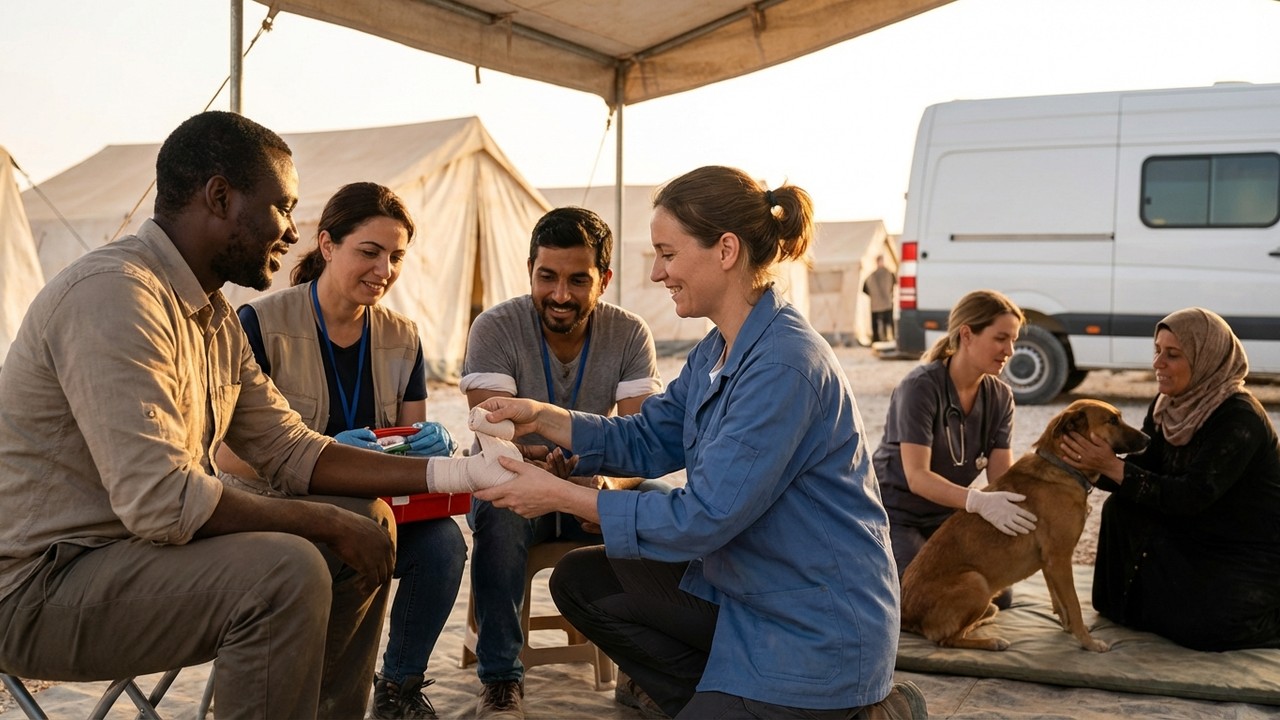
Shelter is not only about a roof. For many displaced people, leaving a beloved animal behind is unthinkable. Animal welfare organizations respond in parallel: the ASPCA and Humane Society International deploy disaster-response teams to care for lost and injured animals so owners are more likely to accept shelter and medical help for themselves (ASPCA Disaster Response) (Humane Society International). Integrating veterinary care with human services reduces suffering across species and preserves family bonds during crises.
This work is happening now: mobile clinics in refugee reception centers, short courses that certify community nurses, and shelter designs that include pet areas and safe spaces for women and children. Those are practical, measurable interventions that lower mortality, reduce trauma, and rebuild stability.
How you can help
- Give to trusted responders: MSF, International Rescue Committee, and ASPCA all support combined health, shelter, and animal-welfare responses.
- Support training programs: donate or volunteer to organizations that train local health workers, like Project HOPE.
- Advocate: write to policymakers to fund humanitarian assistance and health equity initiatives; share trusted reports such as the GHO 2024 to raise awareness.
It is easy to feel small in the face of hundreds of millions in need. But every trained nurse, every family kept intact by inclusive shelter, and every animal reunited with its owner is a concrete victory. When we fund training and design shelters with dignity in mind, we do more than respond — we restore hope. Join a trusted organization, share accurate information, or fund a training slot today. Shelter, health, and compassion can travel together.