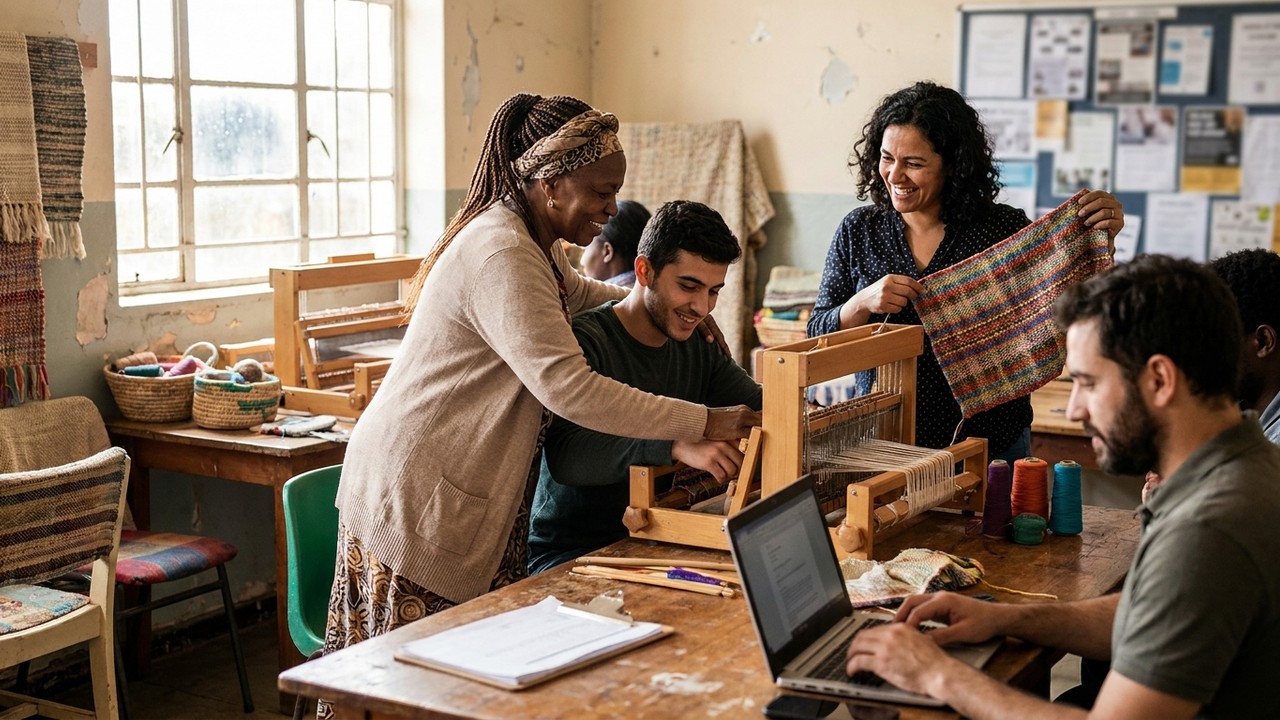
When 17-year-old Asha arrived at a cramped community center on the edge of a refugee settlement, she had one small weaving loom and a bigger desire: to keep her grandmother's patterns alive and to learn the practical skills that might one day pay for university. What started as a quiet table of looms became a classroom, a counseling circle, and a job-training hub. Asha is one among millions whose lives sit at the crossroads of ethnic heritage, life skills, and international upheaval.
Today, more than 117 million people were forcibly displaced worldwide at the end of 2023, a figure documented in UNHCR's Global Trends report, and many of them are young people searching for stability and purpose. (UNHCR Global Trends 2023)
At the same time, the United Nations estimates that roughly 1.2 billion young people aged 15-24 — about 16 percent of the global population — are shaping the future and need opportunities to learn skills that matter. (UN World Youth Report 2022)
Community hubs stitch lives together
Community engagement is not a buzzword; it is where healing and learning meet. Organizations like the Boys & Girls Clubs of America run thousands of local sites that combine safe space, mentoring, and after-school skill-building for millions of young people. Internationally, groups such as the International Rescue Committee provide education and livelihood programs that help displaced youth rebuild careers.
Why ethnic heritage matters in skill-building
Preserving traditional crafts, music, and language often becomes a conduit for practical training. UNESCO's work on intangible cultural heritage highlights how community knowledge can be mobilized for education and tourism that benefits local youth and keeps cultures alive. (UNESCO Intangible Cultural Heritage) Community-led programs that teach marketable skills through cultural practices increase pride, economic opportunity, and intergenerational connection.
Small programs, measurable hope
Nonprofits like Cultural Survival support indigenous communities to lead projects that link heritage with livelihoods, while groups such as Save the Children run life-skills and literacy programs that show improved school retention and confidence among participants. These are not abstract wins: they translate into jobs, into a renewed sense of identity, and into safety nets that protect young people from exploitation.
How you can make a difference
- Support or volunteer at local community centers and youth clubs; they turn spaces into launchpads.
- Donate to organizations working at the intersection of heritage and youth development, such as Cultural Survival or local cultural enterprises.
- Advocate for policies that fund life-skills and vocational training for displaced and marginalized youth.
- Amplify young voices and cultural artists in your networks; visibility creates markets and solidarity.
When communities teach their young, culture and resilience travel together.
Stories like Asha's remind us that solutions are often layered: a loom can teach patience, a mentor can teach resume-building, and a community can teach belonging. There is hope where committed people and strong institutions meet: tools and traditions handed down become economic engines and sources of dignity. Join a local program, give to trusted organizations, or simply start a conversation about heritage and skills where you live — each action threads into a larger safety net for youth everywhere.