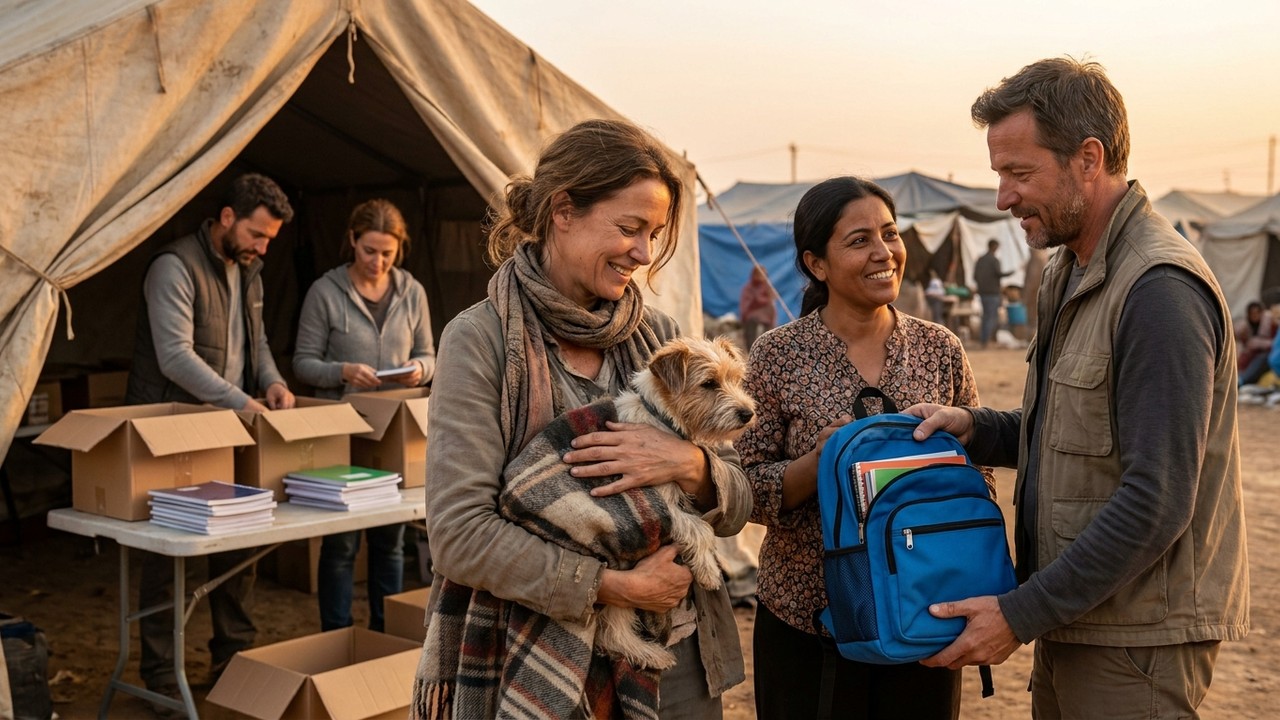
When a little girl arriving at a border camp tucked a trembling terrier into her coat, aid workers saw more than a rescued pet — they saw a lifeline. In a place where classrooms were tents and routines had vanished, that small dog brought a moment of normalcy and a bridge to healing.
Why this matters now
More people are displaced and more animals need us. The UN Refugee Agency reported that forced displacement exceeded 100 million people in 2023, a scale that stretches community services thin and makes coordinated outreach essential. UNHCR documented the trend and called for global solidarity.
"Forced displacement has surpassed 100 million people worldwide." — UNHCR
At the same time, in the United States alone, roughly 6 million companion animals enter shelters each year, according to the American Society for the Prevention of Cruelty to Animals. That number reflects both community hardship and opportunity: shelters and adoption programs are places where compassion, jobs, and recovery intersect. ASPCA statistics
Where community outreach, education, and animal welfare meet
Across cities and camps, programs are following the example of holistic care: pairing child-friendly learning spaces with animal-assisted therapy, and combining refugee education with pet-care workshops that preserve family bonds. Nonprofits are leading the charge. Best Friends Animal Society runs national adoption and community outreach campaigns that reduce shelter intake and promote foster networks, while organizations like Save the Children and UNICEF keep classrooms running for displaced children.
These partnerships produce measurable benefits: stable routines and a caring animal can reduce anxiety in children, making it easier for educators and volunteers to deliver learning. Community outreach that includes veterinary care, adoption drives, and mobile classrooms stretches scarce resources further and reconnects families to meaningful roles.
How you can help today
Small actions add up. If you want to turn concern into impact, here are realistic steps:
- Volunteer at a local shelter or sign up to foster a pet — shelters like Best Friends list opportunities on their site. bestfriends.org
- Support education programs for displaced children through trusted NGOs such as Save the Children or donate to UNHCR’s relief efforts. unhcr.org
- Organize a combined pet-adoption and school-supply drive with neighbors, faith groups, or workplaces — community outreach amplifies every dollar and hour given.
- Share accurate information and local resources on social media and neighborhood boards to connect people with shelter services, tutors, and foster networks.
When communities rally around both people and animals, they rebuild not just infrastructure but dignity and routine. Stories from aid workers and shelter volunteers show that compassion multiplies: a rescued pet can open a child’s heart, and a classroom can become a community anchor.
A hopeful next step
It is easy to feel overwhelmed by numbers, but recall the girl and her terrier — one small act of care can ripple outward. Your time, foster home, donation, or volunteer hour becomes part of a network that keeps children learning and animals safe. Join a local shelter, back organizations that deliver education in crisis zones, or host a neighborhood adoption-and-learning fair. These are tangible ways to practice global solidarity at the community level.
If you want a starting point, visit ASPCA for shelter data, Best Friends to find adoption and volunteer opportunities, and UNHCR or Save the Children to support education for displaced children.
Together, communities can shelter the vulnerable, teach the displaced, and give animals the homes they deserve. That is the work of solidarity — and it begins with one person deciding to act.